Penetration Testing Helps You See… What You Never Thought Could Be Seen
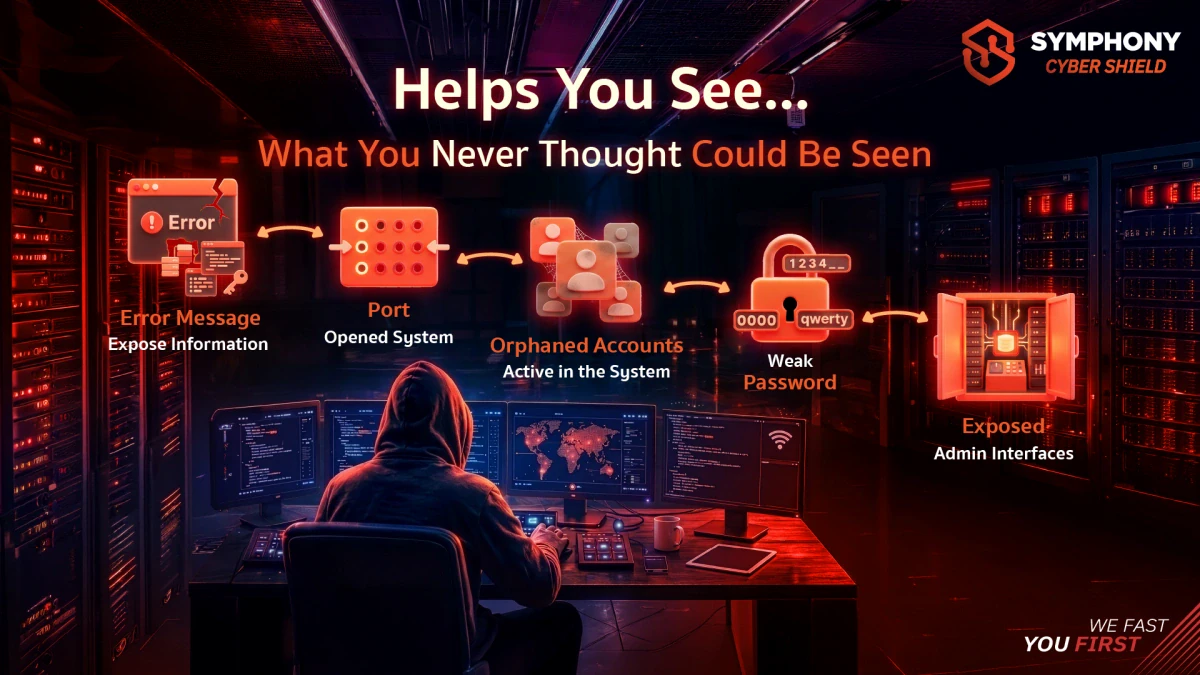
Sometimes, hackers or penetration testers (Pentesters) barely need to use any advanced tools at all. They simply observe what your website or systems are already revealing—details that most people tend to overlook.
For example, an error message may expose information about backend systems. A login page response may hint at whether a particular account exists. Or subtle clues may reveal that a website is running outdated or end-of-life technology.
At this point, they have not even started penetrating the system. Simply by viewing the website, they may already be able to identify weaknesses that could potentially be exploited.
For many systems, the information exposed within the first few minutes may already be enough to answer a hacker’s most important question:
“Where should I start?”
This does not necessarily mean that the system owner has been careless. It is because “the people who build the system” and “the people who attack it” look at the same environment from completely different perspectives.
And that difference can turn seemingly minor weaknesses into much bigger concerns:
- Open Ports: Connections that were opened during system testing and were never closed.
- Orphaned Accounts: Accounts belonging to former employees that remain active in the system.
- Password Patterns: Predictable password conventions used across the organization.
- Shadow Admin Pages: Backend administration pages that remain discoverable after the system goes live.
- Broad Permissions: Access privileges that were temporarily set too broadly and never properly reviewed.
Individually, each of these issues may seem relatively minor. In a lengthy security assessment report, they may even be classified as Low Risk, considered non-urgent, or postponed for remediation.
The real turning point comes when someone starts connecting these small pieces of information together.
A Hypothetical Week in the Life of an Attacker
Without Triggering a Single Security Alert
Monday:
They visit your corporate website and review publicly available information to understand the organization and its digital footprint.
Tuesday:
They review publicly available professional information to gain a better understanding of the organization’s technology environment and teams.
Wednesday:
They interact with publicly accessible business channels and observe technical clues that may unintentionally reveal information about the organization’s systems.
Thursday:
They identify whether previously discovered weaknesses could potentially be connected to other exposed areas within the environment.
Friday:
What initially appeared to be several unrelated, low-risk findings may now form a potential path toward a more sensitive part of the organization’s systems.
Throughout the week, traditional security alerts may not necessarily be triggered because much of the initial activity can resemble normal interactions with publicly available information.
From Security Tools to “Visible Attack Paths”
This is why modern security teams are beginning to ask a different question.
Instead of: “Do we have all the necessary security tools?”
The question becomes: “Can we actually see the potential paths an attacker could take to reach our critical data?”
Once the team begins to understand potential attack paths, the conversation changes:
From “How severe is this vulnerability?”
to “If this vulnerability is combined with other weaknesses in our environment, how far could an attacker potentially go?”
And from “Do we already have this security tool?”
to “If someone starts from our weakest point today, how effectively can we detect, contain, and stop them before they reach our most critical assets?”
A Pentest Report Designed for Action: Turning Technical Findings into an Action Plan
To help answer these questions, our Penetration Testing service goes beyond simply delivering a list of vulnerabilities or a lengthy technical report.
The objective is to provide a clear “Remediation Blueprint” that helps IT and security teams understand the findings, prioritize risks, and take appropriate corrective action.
The report is structured around three key areas:
1. Executive Summary & Attack Path Mapping
For Management
- One-Page Executive Overview: Summarizes key risks from a business perspective—not just a technical one—so management can clearly understand which areas require the most attention.
- Attack Chain Visualization: Illustrates how multiple findings may be connected and how seemingly low-risk weaknesses could potentially contribute to a broader attack path toward critical systems.
2. Actionable Technical Report
For IT & Development Teams
- Proof of Concept (PoC): Provides appropriate evidence from authorized testing to help technical teams understand the nature and impact of identified vulnerabilities.
- Remediation Guidance: Provides clear recommendations and configuration guidance to help IT and development teams address identified issues effectively.
3. Technical Traceability
For Security Teams
- Reconnaissance & Asset Discovery: Provides visibility into identified ports, services, web applications, and other assets—including systems that the organization may no longer realize are externally exposed.
- Testing & Validation Records: Documents relevant activities and findings from the authorized assessment, enabling security teams to compare them with system logs and improve monitoring and detection capabilities across tools such as SIEM and EDR.
Not Just “Checking the Answers” - But Showing You How to Fix the Problem
The goal of a good Penetration Test is not to demonstrate how skilled a hacker is—or how vulnerable your organization may be.
It is to give your organization a clearer view of its security posture from an attacker’s perspective and provide a practical “repair manual” for addressing weaknesses before they can be exploited in a real attack.
See the risks you may have overlooked.
Understand the paths they could create.
Fix them before a real attacker finds them first.
For consultation on Managed Cybersecurity solutions for your organization:
📧 salessecurity@symphony.net.th
☎️ 02 101 1111
