
Sustainability in Environmental Dimension

Climate change, natural resource degradation, and pollution are environmental challenges that Thailand is currently facing. These issues contribute to rising global average temperatures, natural disasters, seasonal changes, and the extinction of species. Moreover, they have significant impacts on quality of life and can cause damage to the economy.
Symphony Communication Public Company Limited is committed to conducting its business with environmental responsibility and friendliness in every process. The company places great importance on protecting the environment and conserving natural resources to help mitigate the impacts of environmental degradation and climate change.




The company has established an "Environmental Management Policy" to provide a framework for efficient and effective environmental practices. The guidelines are as follows:
- Conduct business with a strong commitment to minimizing environmental impacts and adapting to climate change. It emphasizes environmental conservation and the sustainable use of natural resources and energy through the promotion of eco-efficiency and circular economy principles, waste and emission reduction, both direct and indirect greenhouse gas mitigation, efficient supply chain management, as well as environmentally friendly sourcing and service delivery.
- Strictly comply with all applicable environmental laws, regulations, policies, and standards, and cooperates with international agreements and initiatives aimed at preventing and mitigating environmental impacts.
- Regularly assess and monitor environmental performance and promptly responds to any environmental impacts arising from its operations in an appropriate and responsible manner.
- Foster environmental responsibility among its employees through training programs, knowledge sharing, and various activities that encourage participation in proposing ideas and initiatives for environmental and energy conservation. Employees are also encouraged to use natural resources and energy efficiently and responsibly.
- Strive to enhance awareness and understanding among all stakeholders regarding environmental, natural resources, and energy conservation. It also supports and collaborates in publicizing environmental initiatives undertaken by government agencies, private organizations, and the general public to promote sustainable environmental development.
- Support, promote, and collaborate with stakeholders across the value chain, as well as with relevant organizations, to drive effective and sustainable environmental and climate change management initiatives.
Environmental Management Policy
Efficient Energy Management
Energy consumption constitutes a critical component of the Company’s business operations, particularly electricity used for managing network equipment and supporting office operations. The Company therefore places strong emphasis on maximizing energy efficiency while minimizing environmental impact. A target has been established to increase the proportion of renewable energy derived from solar power to no less than 20% of all projects in which such systems are installed.
In addition, the Company has continuously implemented energy efficiency improvement measures within its offices to support the reduction of operating costs and environmental impact. Such measures include upgrading equipment and electrical appliances to energy-efficient models, such as replacing all lighting with LED bulbs, installing high-efficiency air-conditioning units, and conducting regular maintenance, including cleaning condensing units and air filters to ensure optimal system performance.
Concurrently, the Company has promoted employee participation in energy conservation through various awareness campaigns, such as turning off lights and unplugging electrical equipment when not in use, utilizing resources efficiently, and fostering energy conservation awareness as part of the organizational culture.


Water Management
Symphony Communication Public Company Limited operates as a telecommunications and digital infrastructure services provider, which by nature is not considered a water-intensive industry when compared to other industrial sectors.
The Company’s water consumption is limited solely to general domestic use and daily consumption activities, such as water usage within office premises, warehouses, and operational facilities. No water is utilized in the production process or service delivery operations. In addition, the Company does not own any office buildings but leases office spaces within commercial buildings. Water consumption is therefore supplied through legally authorized municipal water providers in the respective areas, with water charges incorporated into the rental fees. Consequently, the Company’s water usage remains relatively low and does not directly impact water resources, nor does the Company face any water-related risks or water stress issues.
Nevertheless, the Company recognizes the importance of water resources as a finite natural resource that is essential to human life and ecosystems. Accordingly, the Company actively promotes awareness among employees at all levels regarding the responsible and efficient use of water, both within the workplace and in daily life, through internal communications and the cultivation of environmentally responsible behavior.


Waste Management
Recognizing waste problem and its impact on the environment, the Company places great importance on waste management in its business operations. We have adopted the 3Rs principle, which includes reducing reusing and recycling with the goal of minimizing the amount of waste sent to landfills or incineration.
For electronic waste and hazardous materials, such as fiber optic cables, network equipment, IT devices, and batteries, we are committed to managing them in accordance with standards and proper methods to reduce environmental impact. We partner with licensed firms approved by the Department of Industrial Works and certified with international environmental management standards to handle electronic waste and hazardous materials.
Additionally, we promote and encourage waste separation within the office, ensuring waste is disposed of or recycled appropriately. It also emphasizes raising awareness among employees about the importance of waste separation, aiming to foster environmentally friendly behaviors.
Climate Change Actions
Climate change represents a significant global challenge that has substantial impacts on human livelihoods, ecosystems, and broader economic and social development. Such impacts include changes in seasonal patterns, increased frequency and severity of natural disasters, biodiversity loss, and shifts in the spread of infectious diseases and disease vectors, all of which continuously affect lives, property, and socio-economic stability.
The Company recognizes the risks and potential impacts of climate change on its business operations and long-term service continuity. Accordingly, the Company places strong emphasis on environmentally responsible business operations alongside comprehensive environmental risk management. The Company focuses on mitigating climate-related impacts through efficient resource and energy utilization, the study and planning of renewable energy adoption, the reduction of greenhouse gas emissions from operational activities, and the development of services that enable organizations and businesses to optimize resource efficiency, reduce greenhouse gas emissions, and accelerate the transition toward a low-carbon economy, while fostering balanced and sustainable growth alongside society and the environment.
To ensure that climate change management and implementation are aligned with the Company’s business direction and sustainability objectives, and are subject to systematic oversight and monitoring, the Company has established a climate governance structure covering the Board of Directors, management, and operational levels. The Board of Directors has assigned the Nomination, Compensation, Corporate Governance and Sustainability Committee to oversee matters relating to climate change management and greenhouse gas emissions reduction, including the establishment of targets, strategies, management approaches, operational plans, and monitoring and evaluation processes to ensure the achievement of short-, medium-, and long-term objectives.
GHG Emission Reduction Targets
To demonstrate its commitment to addressing climate change, the Company has established a target to achieve organizational Carbon Neutrality by 2050 and Net Zero greenhouse gas emissions by 2065.
GHG Emission
The Company’s operational activities that contribute to greenhouse gas emissions consist of the following:
- Direct greenhouse gas emissions (Scope 1): emissions arising from fuel consumption by Company vehicles, backup power systems within the network infrastructure, and refrigerant leakage from air-conditioning systems.
- Indirect greenhouse gas emissions (Scope 2): emissions associated with purchased electricity consumption for network equipment, air-conditioning systems, lighting systems, and office equipment.
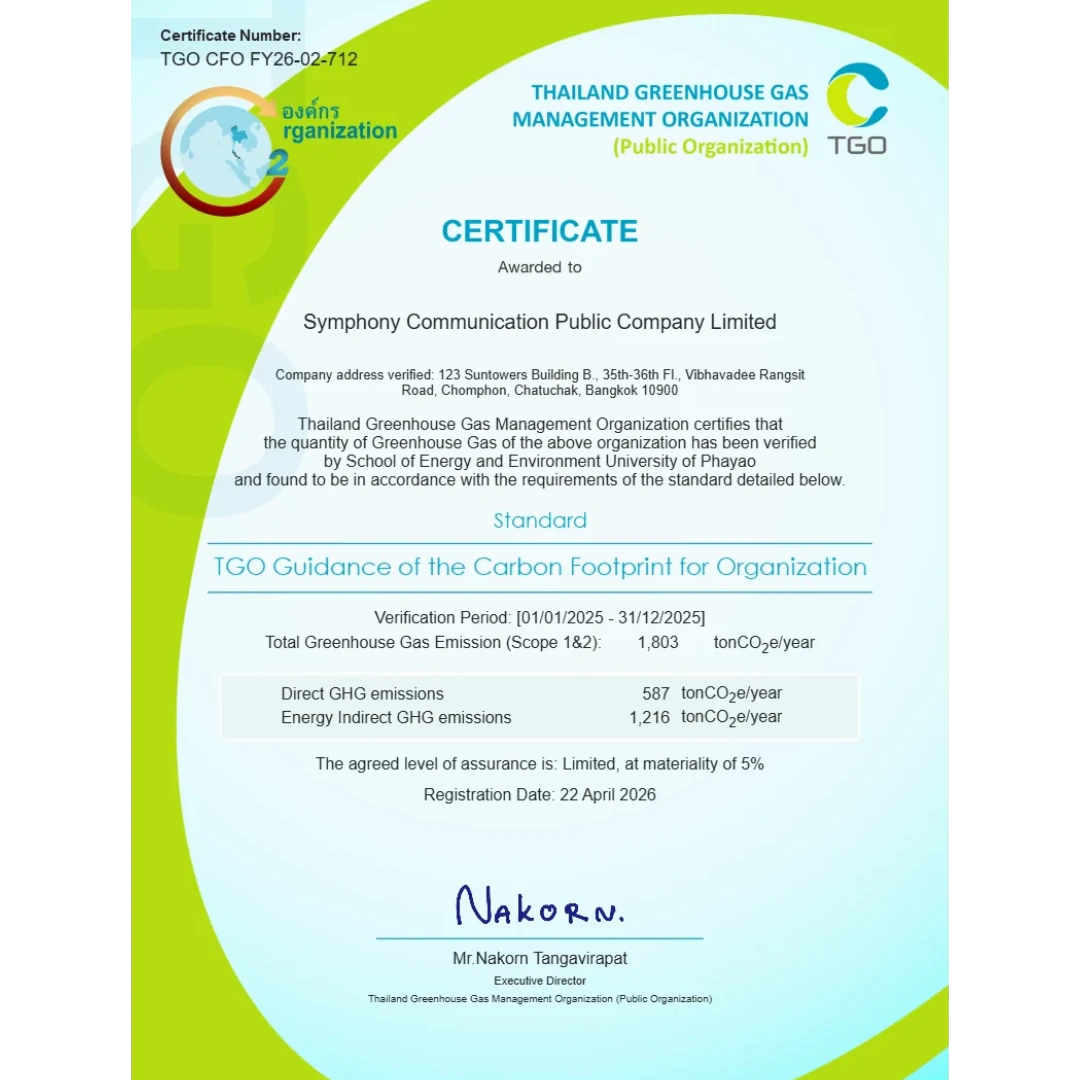
The Company has assessed both direct and indirect greenhouse gas emissions (Scopes 1 and 2), or the Carbon Footprint for Organization (CFO), in accordance with the guidelines of the Thailand Greenhouse Gas Management Organization (Public Organization) (“TGO”). The reporting boundary covers three operational sites, namely the headquarters in Bangkok, the Amata City branch office in Chonburi Province, and the Moalee Submarine Cable Station in Rayong Province.
In 2025, the Company recorded total greenhouse gas emissions of 1,803 tonnes of carbon dioxide equivalent (tCO2e), comprising 587 tCO2e of direct greenhouse gas emissions (Scope 1) and 1,216 tCO2e of indirect greenhouse gas emissions from purchased electricity consumption (Scope 2).
The Company’s 2025 organizational carbon footprint data was verified by an accredited verifier from the Greenhouse Gas Management Certification Unit, School of Energy and Environment, University of Phayao, and was subsequently registered as the Company’s Carbon Footprint for Organization with the TGO in 2026.
GHG Emission Record
| GHG Emission | Unit | 2023 | 2024 | 2025 |
|---|---|---|---|---|
| Total GHG emissions (Scope 1 and 2) | tCO2e | 1,802 | - | 1,803 |
| Direct GHG emissions (Scope 1) | tCO2e | 566 | - | 587 |
| Indirect GHG emissions (Scope 2) | tCO2e | 1,236 | - | 1,216 |
