Next-Generation Submarine Cable Networks: Moving More Data with Greater Energy Efficiency
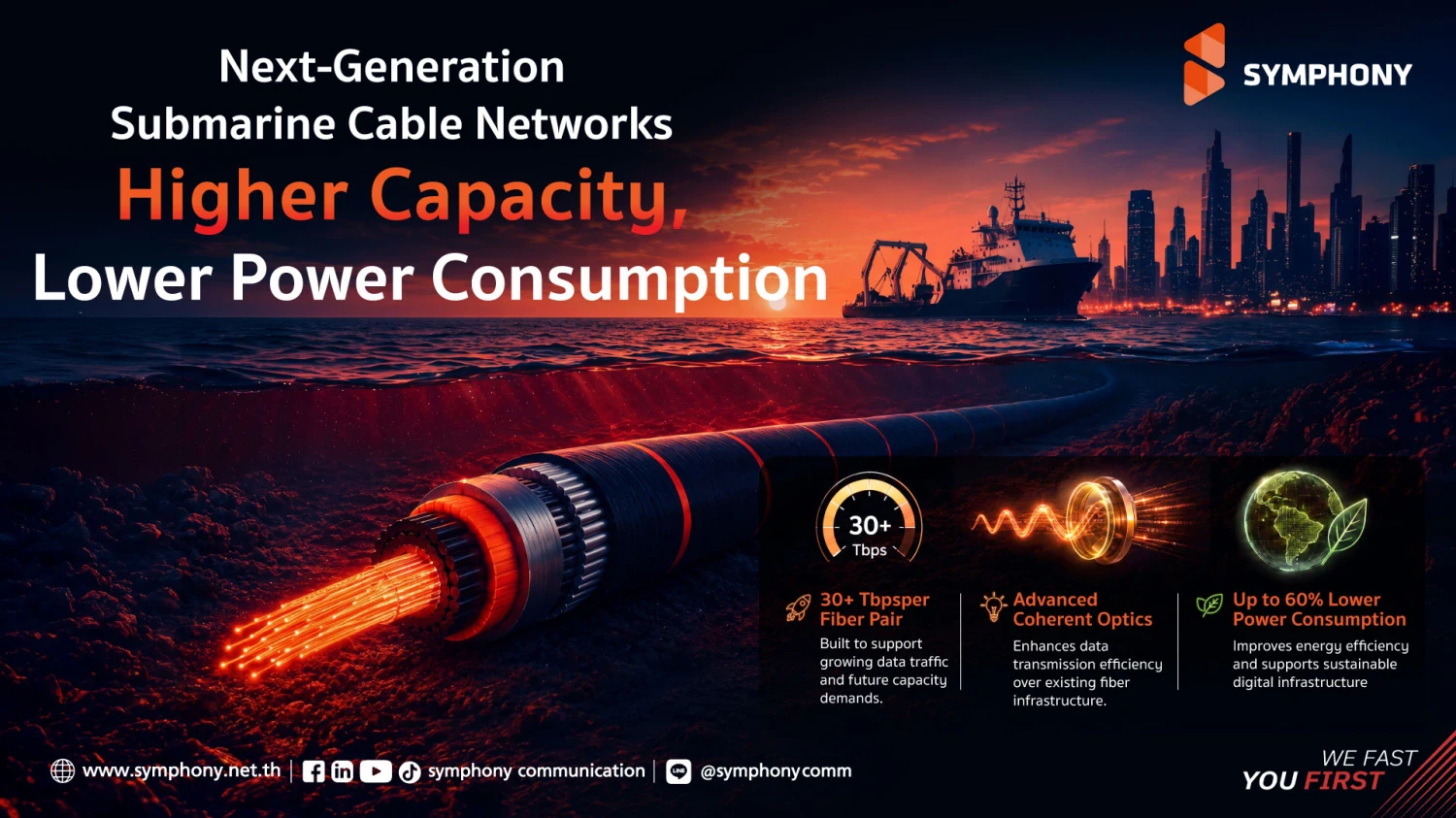
As demand for cross-border data transmission continues to grow, network operators face a critical engineering challenge: how to increase network capacity without having to deploy a new submarine cable system every time demand rises.
Building a new submarine cable system requires significant investment and can take years—from planning, surveying, design, permitting, manufacturing, and installation to commissioning. One important approach is therefore to enhance existing fiber-optic infrastructure through next-generation optical transport technology.
SYMPHONY has upgraded the MCT Submarine Cable System with next-generation coherent optics to increase capacity, improve efficiency, and support continued growth in international data traffic using existing infrastructure.
Using Light to Carry More Data with Coherent Optics
At the core of fiber-optic communications is light, which carries data across long distances.
Coherent optics increases the amount of data that can be transmitted through each optical channel by using multiple properties of light for encoding and signal recovery, including:
- Amplitude — using signal level as part of data encoding
- Phase — using changes in the phase of a light wave to carry additional information
- Polarization — using two polarization states to improve transmission efficiency over fiber
When the optical signal reaches its destination, a coherent digital signal processor, or DSP, processes the signal to help compensate for transmission impairments that occur along the fiber path. These may include chromatic dispersion and polarization-related impairments, along with carrier recovery and forward error correction, depending on system design.
Advances in coherent DSPs, advanced modulation, forward error correction, and silicon photonics enable optical transport networks to improve capacity, reach, and energy efficiency per bit of data transported.
Coherent DSP: The Intelligence of Optical Transport
A coherent optical DSP is a key processing component within a coherent transceiver. It prepares, encodes, receives, and recovers data from optical signals, while helping compensate for channel distortions that occur during fiber transmission.
DSP technology can work with modulation formats, probabilistic constellation shaping, or PCS, and forward error correction, or FEC, to optimize transmission according to optical-link quality and capacity-and-reach requirements.
Next-generation coherent optics can support terabit-class transmission per wavelength in certain configurations. Actual performance depends on distance, fiber characteristics, optical-link quality, and overall network design.
For the latest MCT Submarine Cable System upgrade, SYMPHONY states that the upgraded infrastructure supports capacity of more than 30 Tbps per fiber pair. This upgrade is intended to support growing international data traffic associated with AI, cloud services, OTT platforms, hyperscale data centers, and other digital services. symphony.net
Increasing Capacity with Existing Infrastructure
Upgrading optical transport is not only about increasing capacity. It can also help network operators make more efficient use of existing infrastructure.
- High capacity and scalability: Enhances existing systems to support higher traffic volumes and future capacity demand.
- Spectral efficiency: Increases the amount of data carried within available optical spectrum, improving utilization of existing fiber resources.
- Long-distance transport: Uses DSP, advanced modulation, and FEC to support long-distance transmission based on route characteristics and network design.
- Energy efficiency: Reduces the energy used per unit of data transported through newer coherent-optics technology and more efficient network equipment.
Next-generation coherent-optics technology can reduce network power consumption by up to 60% compared with earlier coherent-optics generations. Actual results depend on network architecture, traffic load, equipment configuration, and the systems being replaced.
What Does a 60% Power Reduction Mean?
To illustrate the potential effect, assume that an existing optical transport system consumes an average of 10 kW of power. If an upgrade reduces power consumption by 60% under otherwise comparable operating conditions, the power reduction would be:
10 kW × 60% = 6 kW
The upgraded system would therefore consume approximately 4 kW, compared with 10 kW for the original system.
If it operates continuously for one year, the illustrative energy savings would be:
6 kW × 24 hours × 365 days = 52,560 kWh
In this example:
- Original system: 10 kW
- Upgraded system: approximately 4 kW
- Power reduction: approximately 6 kW
- Illustrative annual energy savings: approximately 52,560 kWh
These figures are provided only to illustrate the mathematical effect of a 60% reduction in power consumption. They do not represent actual MCT power-consumption data. Actual results depend on pre- and post-upgrade power requirements, system configuration, traffic levels, and operating conditions.
Supporting More Efficient Digital Infrastructure
Increasing capacity while improving energy efficiency per bit reflects the broader concept of sustainable digital infrastructure. It helps make more efficient use of network resources while supporting continued growth in connectivity demand.
For SYMPHONY, applying next-generation coherent optics and digital signal processing to the MCT Submarine Cable System is not simply about increasing speed. It is about increasing the amount of data that can be transmitted over existing infrastructure more efficiently, while supporting improved network energy efficiency.
As data traffic continues to grow, the ability to carry more data over existing infrastructure while using energy more efficiently per bit is an important characteristic of digital infrastructure designed to support cloud services, data centers, and the AI-driven economy.
