How Ready Is Thailand to Become a Regional Digital Connectivity Hub?
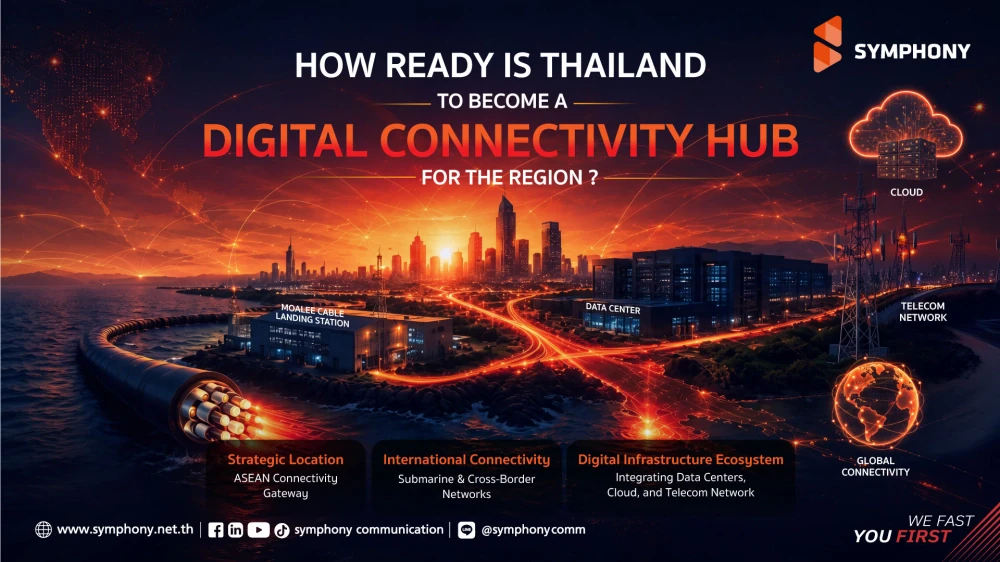
When discussing Thailand’s role as a hub in ASEAN, the country is often associated with healthcare, tourism, and automotive manufacturing. As investment in cloud services, data centers, and digital platforms continues to grow, another important opportunity is emerging: developing the infrastructure needed to connect Thailand’s digital economy with regional and global networks.
Investment in cloud regions and data centers by major technology providers reflects growing interest in Thailand as a location for digital infrastructure. However, data centers alone are not enough to establish a Digital Connectivity Hub. The country also needs reliable energy, telecommunications networks, data center infrastructure, and international connectivity that can operate together as an integrated ecosystem.
In 2026, Thailand’s Board of Investment approved seven data center and data-hosting projects worth more than THB 96 billion in total, reflecting continued investment momentum in the country’s digital infrastructure.
From Data Centers to a Connectivity Ecosystem
As data centers grow in importance, connectivity becomes an essential element of digital infrastructure. Data stored and processed within data centers must still connect efficiently with enterprises, users, cloud platforms, and digital services operating in other locations.
Thailand is therefore not competing only on the number of data centers. It is also competing on the strength of its connectivity ecosystem—one that links domestic data centers with international networks and regional digital infrastructure.
This ecosystem includes data centers, telecommunications networks, international connectivity, cable landing infrastructure, reliable energy, and an investment environment supported by appropriate regulation.
EEC and Rayong: A Strategic Location for Digital Infrastructure
- The Eastern Economic Corridor, or EEC, plays an important role in Thailand’s industrial and infrastructure development. At the same time, Rayong has connectivity infrastructure that can support the development of digital infrastructure, including SYMPHONY’s MOALEE Cable Landing Station.
- The facility supports the MCT Submarine Cable System, which connects Thailand, Malaysia, and Cambodia, and serves as the point where the submarine cable connects to terrestrial networks.symphony.net
In 2025, the EEC Office visited the MOALEE Cable Landing Station to study submarine cable systems and operations. The Office stated that the consideration of a special economic promotion zone in the area aims to strengthen submarine cable infrastructure to support the development of data centers and cloud computing in the EEC.
Having cable landing infrastructure near areas of industrial and digital infrastructure development provides more options for designing connectivity between international networks and domestic data centers. The actual benefits in terms of distance, latency, and route diversity depend on the topology and network design of each service.
Cable Landing Stations: Infrastructure Behind a Digital Hub
A cable landing station is infrastructure that connects submarine cable systems to terrestrial networks.
Data travelling through a submarine cable enters a cable landing station before it is connected to terrestrial networks and delivered to data centers, cloud platforms, internet gateways, or other network providers, depending on the connectivity design.
The connection can be viewed as:
Submarine Cable → Cable Landing Station → Terrestrial Network → Data Center / Cloud / Digital Services
A cable landing station is therefore more than the endpoint of a submarine cable. It is a critical connection layer between international connectivity and land-based digital infrastructure.
From Infrastructure to National Readiness
Developing a Digital Connectivity Hub does not depend on a single type of infrastructure. It requires coordinated development across:
- Data center and cloud infrastructure
- Domestic telecommunications networks
- Diverse and resilient international connectivity
- Cable landing infrastructure
- Reliable energy
- Supportive regulation, skilled talent, and cybersecurity capabilities
The MCT Submarine Cable System and MOALEE Cable Landing Station in Rayong are therefore among the infrastructure elements that expand international connectivity options for the EEC and Thailand.symphony.net+1
For SYMPHONY, developing international connectivity and cable landing infrastructure is part of supporting the infrastructure that connects Thailand with regional and global digital ecosystems.
Thailand may still be on its path toward becoming a Digital Connectivity Hub. However, the continued development of data centers, cloud services, telecommunications networks, and international connectivity will be an important factor in shaping the country’s role in the regional digital economy.
Interested in our services? For more information, please contact us.
📩 GlobalBusinessGroup@symphony.net.th
📱 LINE Official: @symphonycomm
