Don’t Let Your Cybersecurity Protection Expire — Even for a Minute
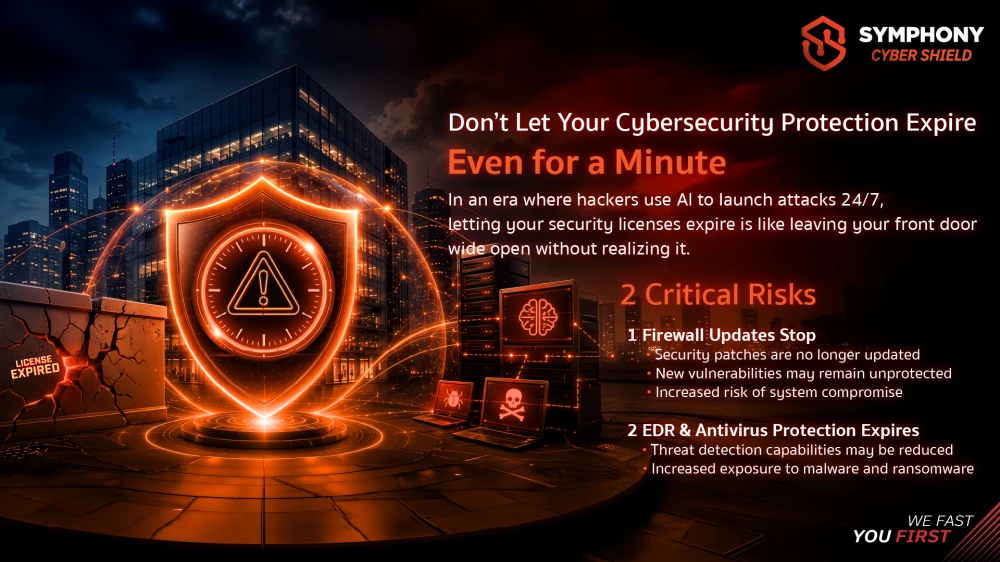
In today’s digital world, cyber threats never stop — and they never take a day off.
Cybercriminals no longer need to carry out every step of an attack manually. With automation, AI-powered tools, and cybercrime services such as Ransomware-as-a-Service (RaaS), attackers can continuously scan for vulnerabilities and target organizations around the clock.
For IT teams and business owners, maintaining cybersecurity is therefore about more than simply deploying a Firewall, Antivirus, or Endpoint Detection and Response (EDR) solution. Organizations must also ensure that their licenses, subscriptions, and security services remain active and continuously updated.
Even a brief interruption in security updates or protection services can create a potential gap that cybercriminals may exploit.
What Could Happen When a Cybersecurity License Expires?
The impact of an expired license varies depending on the product, vendor, and licensing model. In general, however, organizations may lose access to security updates, threat intelligence, signature updates, technical support, or certain detection and protection capabilities.
Here are two common examples.
1. Firewall Updates Stop: When Your First Line of Defense Becomes Vulnerable
A Firewall serves as one of the first lines of defense for an organization, helping control and monitor traffic entering and leaving the network. However, new vulnerabilities and cyber threats are constantly emerging.
Simply having a Firewall in place is therefore not enough if the system is not properly maintained and updated.
When a subscription or related security service expires, an organization may no longer receive security updates, threat signatures, IPS updates, or certain support services, depending on the vendor and product.
If a new vulnerability is discovered during this period, an unpatched or outdated system may face increased exposure. Attackers could potentially exploit the vulnerability to gain unauthorized access to the network, steal sensitive information, or expand their attack to other systems within the organization.
Regularly checking license status and keeping firmware, patches, and security services up to date is therefore just as important as deploying the Firewall itself.
2. EDR and Antivirus Expire: Endpoints Can Become an Entry Point for Cyberattacks
Employee notebooks, desktops, and servers are attractive targets for cybercriminals because they constantly interact with emails, websites, applications, and files.
Antivirus and EDR solutions therefore play an important role in detecting, analyzing, and responding to potentially malicious activity.
If a license or subscription expires, capabilities such as malware signature updates, threat intelligence, cloud-based detection, monitoring, or response features may become limited or unavailable, depending on the product and licensing terms.
This can increase exposure to threats such as:
- Infostealers, designed to steal usernames, passwords, session information, and other sensitive data
- Malware that establishes a foothold and enables attackers to access organizational systems
- Ransomware that encrypts critical files and systems, potentially disrupting business operations
An attack that begins with a single endpoint can potentially spread across the organization if appropriate detection and response measures are not in place.
A Small Security Gap Can Lead to a Much Bigger Business Impact
Cybersecurity is no longer solely an IT concern. When a security incident occurs, the consequences can directly affect business operations.
Organizations may face business downtime, investigation and system recovery costs, data loss or exposure, as well as potential legal, regulatory, and reputational consequences.
For this reason, cybersecurity renewal costs should not be viewed simply as a “license expense.” They are an important part of managing cyber risk and business continuity.
Maintaining continuous protection can help organizations reduce unnecessary exposure and ensure that critical security capabilities remain available when they are needed most.
Don’t Wait Until Your Security License Expires
One of the simplest ways to reduce unnecessary cybersecurity risk is to manage security licenses proactively.
Organizations should regularly review the expiration dates of their Firewalls, EDR, Antivirus, and other security solutions, assign clear ownership for renewals, and establish notifications well before expiration dates.
The status of firmware, patches, signatures, and threat intelligence should also be reviewed regularly to ensure that security systems remain properly updated.
For business-critical systems, renewal planning should begin early enough to accommodate procurement processes, budget approvals, and vendor coordination — without creating a gap in protection.
Because in a world where cyber threats can emerge 24/7, maintaining continuous cybersecurity protection is an essential part of maintaining business continuity.
Keep Your Cybersecurity Protection Continuous
SYMPHONY provides Managed Cybersecurity Services designed to help organizations strengthen their security posture — from cybersecurity planning and security management to ongoing monitoring and threat protection.
With the right security strategy and continuous protection in place, organizations can reduce cyber risk while keeping their business moving forward with confidence.
Interested in Managed Cybersecurity Services for your organization?
📧 salessecurity@symphony.net.th
☎️ 02 101 1111
