SYMPHONY’s AI-Ready Connectivity Infrastructure for the Agentic AI Era
The growth of Agentic AI—AI systems that can plan, use tools, and execute multi-step tasks toward a goal—is changing enterprise digital infrastructure requirements.
Developing AI infrastructure is not only about compute power, GPUs, or data centers. It also requires connectivity infrastructure that enables compute, data, cloud environments, and applications—often distributed across multiple locations—to operate together efficiently.
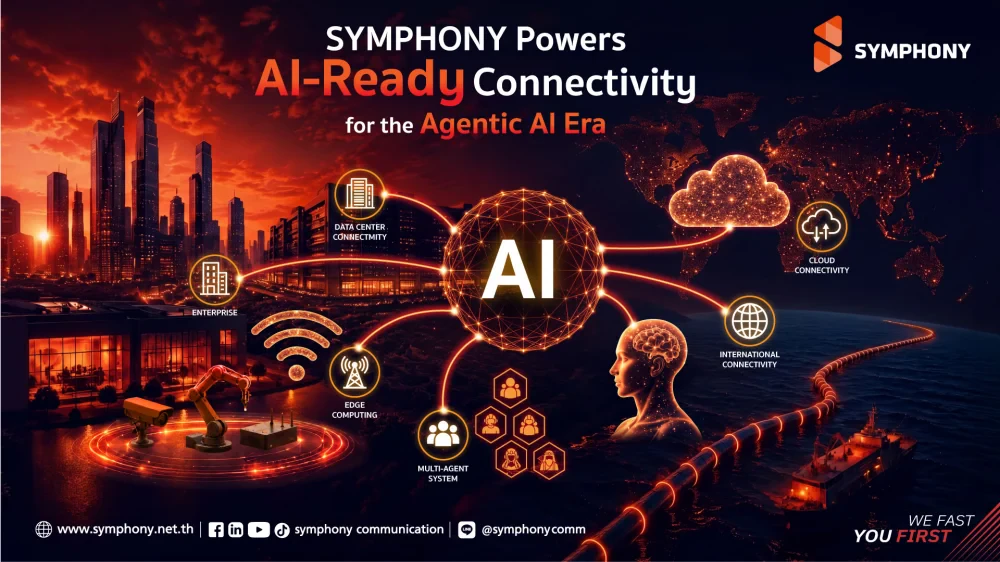
SYMPHONY develops connectivity infrastructure that supports connections among enterprises, data centers, cloud environments, and international networks. These capabilities are important for organizations expanding their use of AI, cloud services, and digital applications.
Why Connectivity Matters for Agentic AI
- Agentic AI differs from conventional applications because it does more than receive an input and generate an output. In systems designed with appropriate permissions and controls, an AI agent can plan tasks, use tools, and interact with external systems such as databases, APIs, enterprise applications, and cloud services to complete multi-step workflows.ibm+1
- For example, an AI agent may retrieve customer information from a database, check inventory through an ERP system, call a logistics-provider API, analyze the results, and return an answer or approval request to the user.
- This type of workflow makes connectivity an important layer for linking applications, data sources, and AI services operating across different environments.
AI-Ready Networks Require More Than Bandwidth
Networks for AI should not be evaluated by connection speed or bandwidth alone. Different workloads have different connectivity requirements.
Key factors include:
- Bandwidth and scalability to support data traffic, datasets, and growing AI workloads.
- Latency to support workloads that require fast responses, such as interactive AI, real-time analytics, or control systems.
- Packet loss management to reduce retransmissions and maintain data-transfer performance.
- Jitter control, which matters for applications that require consistent data-delivery timing, particularly real-time communications and time-sensitive workloads.tsapps.nist
- Reliability and availability to support applications and digital services that depend on continuous connectivity across multiple systems.
- Security and Access Control: Enabling secure connectivity between systems, alongside application-level controls that govern which data and tools AI agents can access
- AI-ready connectivity is therefore not simply the “fastest” network. It is a network with capacity, performance, reliability, security, and scalability aligned with the needs of each workload and the organization’s business requirements.
From AI Models to Agentic Workflows
A conventional AI model may receive an input and generate an output in one or a few steps. An agentic workflow, however, may involve decisions, tool calls, and responses to intermediate results.
A simplified workflow may look like this:
User → AI Agent → Enterprise Data → API or Application → Cloud Service → AI Agent → Response
As organizations move toward multi-agent systems—where several AI agents take on specialized roles and coordinate with one another—the number of system calls and data exchanges may increase with workflow complexity.
However, actual traffic volume depends on the architecture, data locality, caching strategy, model design, and application workflow.
Distributed AI: When Compute and Data Are Not in One Place
In real-world environments, AI infrastructure may not be contained within a single data center. An organization may keep sensitive data in private infrastructure, use selected AI models or services in a public cloud, run applications in a data center, and perform certain processing tasks at the edge.
This creates a distributed AI environment in which compute, data, and applications operate across multiple locations:
Edge ↔ Enterprise ↔ Data Center ↔ Cloud ↔ AI Platform
As infrastructure becomes more distributed, connectivity becomes the data-transport layer that links these resources together.
This is why organizations should plan compute and connectivity together, rather than invest in GPUs or data centers first and address network design later.
International Connectivity for AI and Cloud
AI and cloud infrastructure may be distributed across national borders. Organizations can use cloud regions, data centers, digital platforms, and AI services located in other countries or regions.
International connectivity is therefore an important element of AI-ready infrastructure for workloads that operate across borders. It connects organizations in Thailand with cloud environments, data centers, and digital ecosystems overseas.
International connectivity may use terrestrial networks, submarine cable systems, or a combination of both, depending on the destination, service design, and network architecture.
SYMPHONY lists International Network Connectivity, the MCT Submarine Cable System, Data Center Interconnect (Global), and Cloud Direct Connect Service as part of its service portfolio for connecting enterprises with domestic and international digital environments.
Network Readiness Before Scaling AI
As organizations move AI initiatives from proof of concept to production, the volume of data, number of applications, and number of inter-system connections may increase.
Assessing AI network readiness should therefore go beyond internet bandwidth. Organizations should consider:
Bandwidth → Latency → Packet Loss → Jitter → Reliability → Security → Scalability → Cloud and International Connectivity
Each AI workload should have clear requirements for data volume, acceptable latency, application criticality, redundancy, security, and access controls.
For organizations preparing infrastructure for AI, the challenge does not end with acquiring GPUs or selecting a cloud platform. It also involves designing connectivity that links these resources together effectively.
In the AI era, infrastructure capability is not measured only by the question, “How fast can we compute?” It must also address another question:
“How effectively can we connect data, compute, applications, and cloud environments so they can operate together?
Interested in our services? For more information, please contact us.
📩 GlobalBusiness@symphony.net.th
📱 LINE Official: @symphonycomm
