When a Cable Cut Becomes a Business Continuity Risk
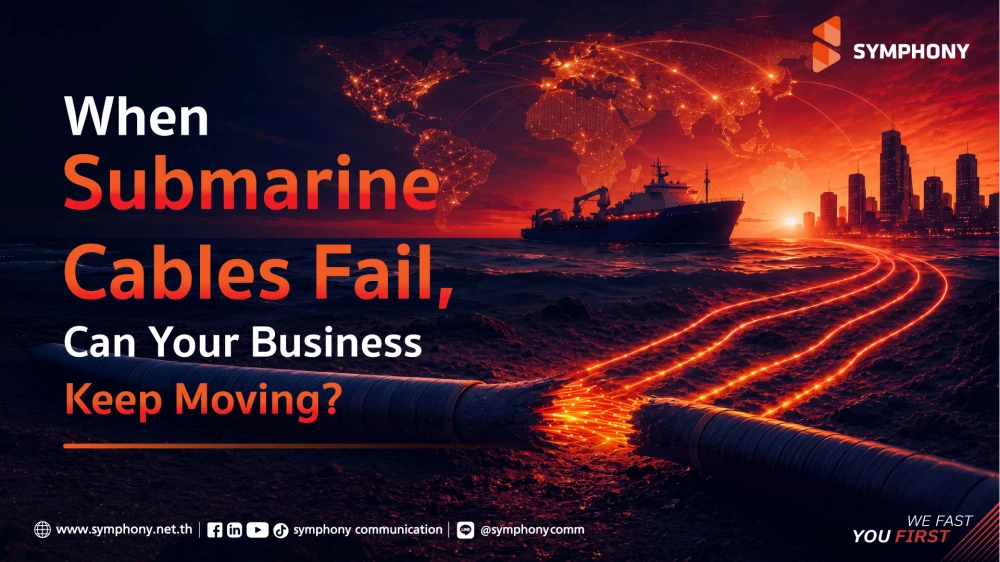
In the digital economy, discussions about connectivity often focus on Gigabit or Terabit speeds and the need for more bandwidth as data volumes continue to grow. But network engineering must also address another important reality: no network can eliminate every risk associated with physical infrastructure failure.
Submarine cables are among the most important components of global communications infrastructure. They support international data exchange and connect services ranging from cloud platforms and financial services to global digital applications.
However, this critical infrastructure remains exposed to physical risks. The International Cable Protection Committee (ICPC) reports approximately 150–200 submarine cable faults globally each year, with an estimated 70–80% caused by accidental human activity, particularly fishing and vessel anchoring.iscpc
A submarine cable cut does not necessarily mean that internet services stop immediately. Where spare capacity and appropriate routing policies are available, traffic may be rerouted through alternative paths. However, an incident can still reduce available capacity, create congestion, increase latency, or disrupt services when insufficient redundancy is in place.
For global enterprises, cloud providers, hyperscalers, and digital platforms, evaluating network infrastructure is therefore not only about asking, “How fast is the network under normal conditions?” It is also about asking, “How well can the network continue operating when a primary route fails?”
When International Connectivity Becomes Business-Critical
International connectivity was once viewed primarily as a channel for accessing overseas internet services. Today, as organizations rely more heavily on cloud platforms, SaaS applications, and cross-border digital services, it has become part of business-critical infrastructure.
Many essential business systems now operate across data centers and national borders. These may include cloud applications, financial transactions, ERP platforms, supply-chain systems, data replication, video conferencing, and digital customer experiences.
The impact of a cable fault can therefore develop through a chain of events:
Cable Cut → Capacity Reduction → Traffic Rerouting → Congestion or Higher Latency → Application Performance Impact → Business Impact
For example, if part of an international network’s capacity becomes unavailable, traffic may be redirected to an alternative route where the network design supports failover. Services may remain online, but the new route could be longer, have less available capacity, or carry more traffic than usual. This can affect network performance and the applications that depend on it.
For businesses operating around the clock, maintaining connectivity during an incident is just as important as having sufficient bandwidth during normal operations.
The Cost of Connectivity Downtime
The cost of a network outage is not limited to connectivity fees. It can affect employee productivity, customer transactions, supply-chain operations, digital services, and service-level commitments.
Organizations can estimate initial business exposure using a simple concept:
Potential Transaction Value Affected ≈ Downtime (Hours) × Business Value per Hour
Example:
- Business Value: THB 500,000 per hour
- Downtime: 2 hours
- Potential Business Impact: THB 1,000,000
This example is illustrative only. It does not represent SYMPHONY service data or financial information.
Actual impact can also include reduced employee productivity, service-level agreement exposure, customer-experience issues, incident-management costs, and potential reputational effects.
Investment in network resilience should therefore not be evaluated only by asking, “What does a backup connection cost?” Organizations should also consider, “What could the business be exposed to if connectivity becomes unavailable?”
Why Submarine Cable Repairs Take Time
Repairing a submarine cable is more complex than repairing terrestrial fiber. After a fault occurs, the cable operator must identify the approximate fault location, coordinate cable repair vessels and relevant authorities, travel to the repair area, recover the cable from the seabed, repair and splice the damaged section, test the system, and return the cable to the seabed.
The timeline can be affected by the availability of repair vessels, weather and sea conditions, permit requirements, and coordination across maritime jurisdictions. The International Telecommunication Union (ITU) notes that regulatory complexity and permitting processes can delay the start of repair operations.
This is why network resilience must be designed before a cable cut occurs. Businesses should not need to wait for a cable repair to be completed before they can restore critical operations.
Combining Terrestrial and Submarine Connectivity
A resilient international connectivity architecture may combine multiple infrastructure types to provide options aligned with application criticality, capacity requirements, latency objectives, and business continuity needs.
SYMPHONY provides International Network Connectivity and the MCT Submarine Cable System to support enterprises' domestic and international connectivity requirements.”
Organizations should evaluate the actual physical routes, diversity level, available capacity, latency, service-level agreement, incident-response process, and alignment with business continuity plans—not bandwidth alone.
Visibility and Operational Readiness
Physical infrastructure is only one part of network resilience. The ability to monitor, identify, and respond to network conditions is equally important.
Real-time network monitoring helps operations teams track network availability and performance, detect abnormalities, assess potential impact, and respond more quickly during an incident.
Traffic and path management can help direct traffic based on network conditions and reduce the operational effect of an outage, depending on the architecture, routing policy, and service configuration in place.
Ultimately, network resilience does not come from a single backup circuit. It comes from the combined strength of:
Physical Diversity + International Connectivity + Monitoring + Traffic Management + Operational Readiness
For cloud providers, digital platforms, hyperscalers, and enterprises that rely on international connectivity around the clock, these capabilities are an essential part of business continuity.
In a world where data and business operations remain connected 24 hours a day, the critical question is not only:
“How fast is the network when everything works normally?”
It is also:
“When the primary route fails, can the business continue to operate?
Interested in our International Connectivity services? For more information, please contact: 📩 GlobalBusiness@symphony.net.th
📱 LINE Official: @symphonycomm
