Modern Network Security: What IT Teams Need to Know
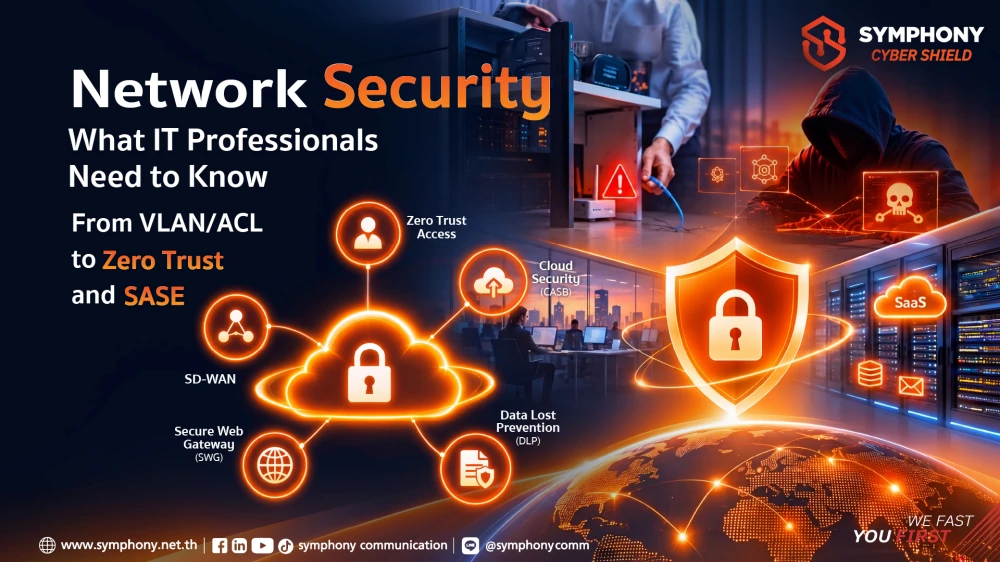
One thing many organizations underestimate when it comes to Network Security is the assumption that “segmenting the network with VLANs and configuring VLAN Access Control Lists (ACLs) to separate traffic across multiple layers” is enough to protect against security risks.
But this could become a hidden “ticking time bomb.”
As organizations grow, traditional network architectures that rely heavily on IP Subnets or LANs as the foundation of security can become vulnerable points that attackers may exploit to expand their access across the organization.
User Behavior and the Hidden Threat Under the Desk
Consider a scenario that can easily happen in today’s workplace.
An employee connects a portable Wi-Fi router to the LAN port under their desk to create a personal wireless network. Or an external visitor walks into a meeting room and connects a laptop directly to a LAN port to give a presentation — without proper access controls in place.
These seemingly harmless devices or connections could become potential “backdoors” into the corporate network, creating opportunities for attackers to spread malware or ransomware.
Hackers do not care which department a VLAN belongs to.
What matters to them is simply:
“Can I reach a critical system from here?”
If network policies are too permissive, user credentials are compromised, or communication between VLANs is not properly controlled, attackers may begin with a small foothold and gradually move toward servers, network shares, or other critical systems that remain accessible.
This is known as Lateral Movement.
Once attackers can move laterally through the network, the impact may no longer be limited to a single device. They can attempt to discover additional systems and privileges, expand their access, and potentially encrypt critical files before the IT team even realizes what is happening.
When Security Based on IP Addresses Is No Longer Enough
Managing security by configuring Access Lists on individual switches can become increasingly complex as the network grows.
It also increases the risk of configuration errors that may disrupt business systems or unintentionally create new security gaps.
Modern organizations therefore need to design Network Security with greater depth.
Instead of looking only at an endpoint’s IP address or VLAN, security policies should also consider:
Who is connecting?
What device are they using?
Which systems should they be allowed to access?
This is at the heart of Zero Trust and Identity-based Segmentation.
For On-Premises environments, modern network architectures can adopt a more Identity-driven approach, with security controls applied at two levels:
Macro-Segmentation
Macro-segmentation separates major network groups at the architectural level — for example, through Virtual Routing — to isolate IoT devices, employees, guests, and other network groups.
The objective is to reduce unnecessary visibility and communication between systems that do not need to interact with each other.
Micro-Segmentation
Micro-segmentation introduces more granular access controls at the individual user or device level.
The system can use Identity Tags or similar identity-based attributes to apply access policies.
For example, if a user is identified as belonging to the HR group, the appropriate policy can follow that user regardless of where they sit, which LAN port they connect to, or which supported Wi-Fi network they use.
If HR users do not require access to Finance servers, the policy can restrict that access accordingly.
This helps limit the potential blast radius if an account or endpoint is compromised, preventing a security incident from spreading freely across the organization.
From the Office to Anywhere: Extending Security with SASE
However, the challenge no longer exists only inside the office.
In the era of Hybrid Work, many applications have moved to the Cloud and SaaS environments, while employees can work from almost anywhere.
Identity-based Segmentation within the office alone may therefore no longer be sufficient.
At the same time, using completely separate security tools for users inside and outside the office can increase management complexity and potentially create gaps between different security policies.
This is where SASE (Secure Access Service Edge) comes into the picture.
SASE brings together networking capabilities, such as SD-WAN, with cloud-delivered security capabilities to provide secure access under a more unified security framework.
Depending on the SASE platform and architecture, organizations can combine capabilities such as Zero Trust Network Access (ZTNA), Cloud Access Security Broker (CASB), Secure Web Gateway (SWG), and Data Loss Prevention (DLP) to protect users and data across different locations.
Consistent Protection Wherever Employees Work
With an appropriate SASE architecture, users can be authenticated and devices can be evaluated before access is granted.
Whether employees are working from home, a coffee shop, another branch office, or overseas, security policies can be applied based on identity, device posture, context, and access requirements.
Solutions may also use endpoint agents or other access methods to support ZTNA, helping organizations provide controlled access to applications without automatically trusting users simply because they are connected to the corporate network.
More Comprehensive Protection
SASE is not only about controlling who can access which applications.
Depending on the solution, it can also incorporate capabilities such as:
- CASB to provide visibility and control over cloud application usage
- Secure Web Gateway (SWG) to help protect users from web-based threats
- Data Loss Prevention (DLP) to help reduce the risk of sensitive information leaving the organization inappropriately
- ZTNA to provide application access based on identity and defined security policies
The goal is to provide more consistent security controls across office, branch, remote, and cloud environments.
The Modern Network Security Architecture
Whether employees are working inside the office through the corporate LAN or connecting remotely through cloud-based environments, the key is to enforce consistent and unified security policies wherever possible.
The ultimate principle is simple:
No user or device should be trusted automatically.
This is the foundation of Zero Trust.
Building a secure, stable, and flexible network architecture today is therefore not about trial and error or simply adding more ACLs whenever a new requirement appears.
Organizations need to consider the entire environment together:
LAN infrastructure, Cloud and WAN connectivity, Identity and Access Control, Network Segmentation, Security Policies, and Cyber Risk.
The objective is to create an architecture that can determine who is connecting, what device they are using, what they should be allowed to access, and how much trust should be granted — regardless of where they are working from.
Don’t let traditional ACLs become your organization’s only line of defense.
Modern Network Security requires an architecture designed to reduce attack paths, limit lateral movement, and apply appropriate access controls across an increasingly distributed IT environment.
Strengthen Your Organization with Managed Cybersecurity
SYMPHONY is ready to help organizations strengthen their Network and Cybersecurity architecture with solutions designed around modern business environments and evolving cyber threats.
Interested in Managed Cybersecurity solutions for your organization?
📧 salessecurity@symphony.net.th
☎️ 02 101 1111
