VA Scan or Pentest? What Organizations Need to Know
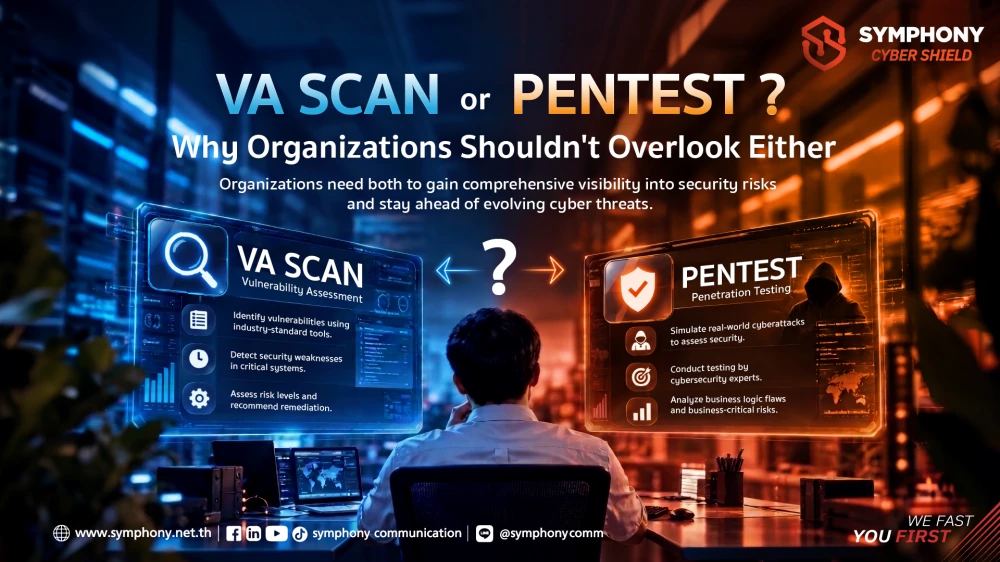
“We’ve already completed a VA Scan. Do we still need a Pentest this year?” Or, “If we’ve just completed a Pentest, can we skip the next VA Scan?”
These are common questions IT Managers often hear from executives or finance teams when requesting approval for the annual cybersecurity budget.
At first glance, Vulnerability Assessment (VA Scan) and Penetration Testing (Pentest) may seem to serve the same purpose: identifying security vulnerabilities within an organization’s systems.
So why would an organization need both?
The answer is that VA Scan and Pentest have different objectives, methodologies, and levels of depth. For many organizations, using both approaches together can provide a more complete view of cybersecurity risks than relying on either one alone.
As organizations today must consider Cybersecurity, Risk Management, and Compliance together, understanding the difference between these two approaches is no longer just a “technical” matter. It is an important part of an organization’s overall cyber risk management strategy.
VA Scan vs. Pentest: What’s the Difference?
| Comparison | Vulnerability Assessment | Penetration Testing |
|---|---|---|
| 1. Primary Objective | Identify vulnerabilities that may exist within systems. | Simulate cyberattacks to determine whether vulnerabilities can actually be exploited and what impact they could cause. |
| 2. How It Is Performed | Primarily uses automated tools, supported by review and analysis of the results. | Primarily performed by cybersecurity professionals or Ethical Hackers using specialized tools and techniques. |
| 3. Results | Provides a list of identified vulnerabilities, severity levels, and remediation information. Automated results may require further review to eliminate False Positives. | Provides in-depth testing results, evidence or Proof of Concept within the agreed scope, potential impact, and remediation recommendations. |
| 4. Frequency | Can be performed regularly, such as monthly, quarterly, or following significant system changes, depending on the organization’s risk profile. | Typically scheduled according to risk level, regulatory or compliance requirements, relevant standards, or after significant system changes. |
| 5. Key Strength | Quickly assesses a broad range of systems and is well suited to continuous vulnerability monitoring. | Provides deeper analysis and helps determine whether vulnerabilities or attack paths could lead to real-world impact. |
Simply put:
VA Scan answers: “What vulnerabilities exist in our systems?”
While Pentest goes a step further: “If someone actually attacks us, how far could they get?”
The two approaches are therefore not designed to directly replace each other. Instead, they can complement one another to provide a clearer and more comprehensive view of an organization’s security risks.
Isn’t a VA Scan Alone Enough?
One of the key advantages of a VA Scan is its ability to assess a large number of systems quickly, making it suitable for regular vulnerability monitoring.
For example, whenever new software is installed, configurations are changed, systems are updated, or new vulnerabilities are disclosed, a system that appeared secure last month may become exposed to new risks.
However, automated scanning tools cannot fully understand business logic or the context of every system in the same way a cybersecurity professional can. Some findings may also be False Positives that require additional validation.
This is where Pentest adds another layer of value.
Pentesters can analyze vulnerabilities within the context of the actual environment, apply the mindset and techniques of real-world attackers, and conduct controlled testing within an authorized scope to determine whether a vulnerability can actually be exploited and how significant the resulting business impact could be.
If We’ve Already Done a Pentest, Do We Still Need VA Scans?
Think of a Pentest as a Point-in-Time Assessment — a snapshot of your organization’s security posture at a specific moment.
Your systems may have been thoroughly tested on the day of the Pentest, but your IT environment continues to change afterward.
New servers are deployed. New applications are installed. Configurations are modified. New patches are released. And most importantly, new vulnerabilities continue to be discovered.
Passing a Pentest today does not mean that new vulnerabilities will not emerge several months later.
Performing VA Scans periodically between Pentest cycles can therefore help organizations identify newly introduced vulnerabilities and reduce the amount of time those vulnerabilities remain undetected within the environment.
It’s Not Just About Security — Compliance Matters Too
Beyond technical security, another important topic IT Managers need to communicate to executives is Cybersecurity Compliance and Risk Management.
Thailand has the Cybersecurity Act B.E. 2562 (2019), together with other laws, regulations, and standards related to the security of information systems and data.
The specific requirements applicable to an organization may vary depending on its industry, systems, the type of data it handles, and its regulatory status.
1. For Critical Information Infrastructure (CII) Organizations
Organizations classified as Critical Information Infrastructure (CII) are subject to cybersecurity risk management and security requirements under applicable laws and regulatory frameworks.
Vulnerability assessments and security testing can therefore serve as important tools within an organization’s risk management process and help demonstrate its preparedness to respond to cyber threats — commonly referred to as Cyber Resilience.
However, the appropriate scope and frequency of assessments should be determined according to the requirements applicable to each organization, relevant standards, and the risk level of the systems involved.
2. The Connection with Personal Data Protection
For organizations that process personal data, maintaining appropriate security measures is also an important consideration under Thailand’s Personal Data Protection Act (PDPA).
Organizations should implement security measures appropriate to their level of risk to help protect personal data against unauthorized or unlawful loss, access, use, alteration, or disclosure.
VA Scan and Pentest can form part of an organization’s cybersecurity measures by helping identify and address vulnerabilities before they are exploited.
This can help reduce the risk of a Data Breach, as well as the potential business, legal, regulatory, and reputational consequences that may follow.
How Do You Explain the Need for Both to Management?
Instead of simply saying, “We need both because the IT team says so,” explain the investment from a Business Risk perspective:
“Pentest provides an in-depth security assessment at a specific point in time to determine how much impact a real attacker could potentially cause. However, new vulnerabilities can emerge throughout the year. Regular VA Scans help identify risks that appear between Pentest cycles, allowing the organization to address vulnerabilities earlier and reduce the likelihood of a small security weakness developing into a Security Incident or Data Breach.”
From this perspective, budgeting for both VA Scan and Pentest is not about paying for two overlapping activities. It is about using two different approaches to manage different aspects of cybersecurity risk.
VA Scan = Continuous vulnerability identification Pentest = In-depth security testing
When both approaches are combined with effective Patch Management, Remediation, and Follow-up, organizations can establish a more effective and systematic Vulnerability Management process.
Strengthen Your Organization’s Cybersecurity with a Systematic Approach
Whether your organization is planning a Vulnerability Assessment (VA Scan) to continuously identify and monitor system vulnerabilities or requires professional Penetration Testing (Pentest) to evaluate the resilience of your systems through controlled attack simulations, SYMPHONY is ready to support you.
Our cybersecurity specialists can help organizations design an assessment approach that aligns with their IT environment, risk profile, applicable requirements, and budget.
Because the goal should not simply be to “pass the assessment.”
The real goal is to understand where your risks are — and address them before they become real security incidents.
Talk to SYMPHONY’s cybersecurity specialists today to plan the right VA Scan and Penetration Testing approach for your organization.
Interested in Managed Cybersecurity Services for your organization?
📧 salessecurity@symphony.net.th
☎️ 02 101 1111
