
Materiality
Symphony Communication Public Company Limited attaches importance to the management of both internal and external sustainability issues and has thus instituted a materiality assessment and prioritization process in compliance with the Standards of the Global Reporting Initiative (GRI).
The Company compiles and assesses issues related to sustainable development through materiality assessment, which places emphasis on the context of sustainability, global and regional trends, and direction in the telecommunication industry, while taking into account the Company’s operational strategies and risk factors both at present and in the future that may provide impacts or create opportunities for the Company’s business operations.



Identified and categorized sustainability topics are subjected to a formal assessment and prioritization process, guided by the principles of the GRI Universal Standards. The Company also applies the concepts of Double Materiality and a Multi-Stakeholder Approach to ensure a comprehensive evaluation of impacts. This includes consideration of positive and negative impacts of the Company’s operations on stakeholders, society, and the environment (outward impacts); and the potential financial and strategic implications of sustainability issues on the Company’s long-term value creation and business performance (inward impacts).
The assessment process is conducted through interviews and online surveys administered to selected external stakeholders using purposive sampling, as well as online surveys for internal stakeholders. The feedback obtained is analyzed quantitatively, with each issue evaluated based on the severity and likelihood of its potential impacts on both the Company and its stakeholders. The results are then plotted in a Materiality Matrix, where:
- The Y-axis represents the significance of environmental, social, and governance (ESG) impacts on stakeholders; and
- The X-axis represents the significance of ESG impacts on the Company’s business operations.
Based on this assessment, sustainability topics are classified into three levels of materiality:
- Very Critical: issues that have significant impacts on the Company’s sustainability performance and strategic objectives.
- Moderately Critical: issues that require appropriate management but are not considered critical.
- Less Critical: issues with limited impact that can be managed within normal business operations.

The results of the materiality assessment and prioritization are presented to the Chief Executive Officer for review to ensure alignment with the Company’s business context, strategic direction, and long-term objectives.
The Nomination, Compensation, Corporate Governance and Sustainability Committee is responsible for reviewing and endorsing the Company’s material sustainability topics, prior to submission to the Board of Directors for approval.
Materiality Assessment Results
In 2023, the Company had a total of 20 ESG topics and categorized the topics into 3 levels according to the significance of their impact on the Company and stakeholders, which are very critical, moderately critical, and less critical.
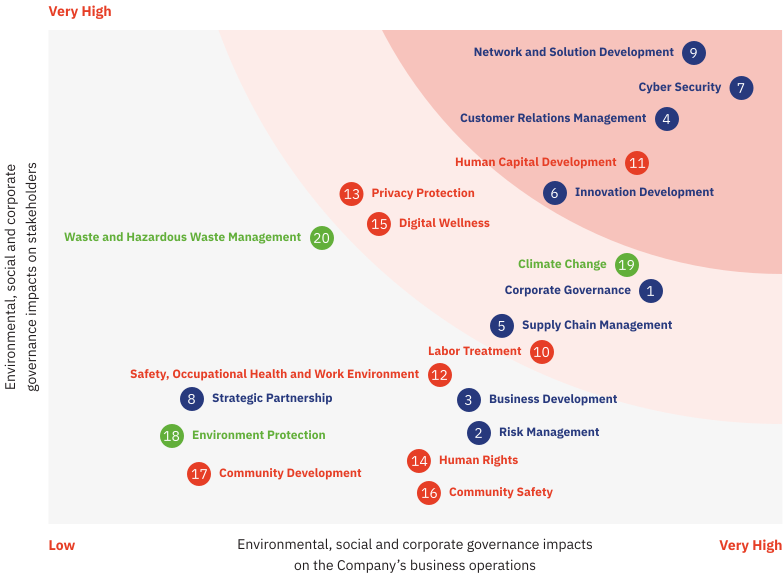
Summary of ESG topics

Economic and Corporate Governance Dimension
- 1 Corporate Governance
- 2 Risk Management
- 3 Business Development
- 4 Customer Relations Management
- 5 Supply Chain Management
- 6 Innovation Development
- 7 Cyber Security
- 8 Strategic Partnership
- 9 Network and Solution Development
ESG materiality

Social Dimension
- 10 Labor Treatment
- 11 Human Capital Development
- 12 Safety, Occupational Health and Work Environment
- 13 Privacy Protection
- 14 Human Rights
- 15 Digital Wellness
- 16 Community Safety
- 17 Community Development
ESG materiality

Environmental Dimension
- 18 Environment Protection
- 19 Climate Change
- 20 Waste and Hazardous Waste Management
ESG materiality